Tuesday, January 31, 2012

Ladybug Garden Art

I thought you might enjoy a fun easy project for your garden...the Ladybug. If you are experienced or hopelessly uncrafty, this is a sure winner. Experience level=Easy! Can be completed in a few hours, including drying time.
We get so many compliments on how cute our bugs are!
 Here's what you will need:
(1) bowling ball ( I saved myself some work and chose a red ball)
about 2 ft of medium wire
black craft paint, water based
spray gloss polyurethane
(2) plastic googly or animal eyes
(1) sponge
glue
optional: a planter dish


You can easily find bowling balls at your local thrift store for a few dollars.(Hint: Most of these bowling balls come with gloves, bags or shoes. Offer to give those back to the thrift store and offer to buy just the ball and you'll get a better deal.) You can save yourself some time by choosing a red one, so that you will only have to paint the black parts. If you cannot find a red one, think other colors like orange or yellow. If you cannot find anything but a black ball, simply reverse the instructions and use red paint instead of black (see photo).


Place the freshly cleaned bowling ball in front of you with the 2 holes in front and the third hole on top. The two holes will become the eyes and the third hole the antenna. I used regular water based craft paint and painted a wide stripe down the center (see photo) leaving two big red circles on the sides. Then I painted large black dots within those red circles.Then I gave the entire ball a coat of spray gloss polyurethane to protect it from the weather.


Then when everything is dry, stick the sponge down into the third hole. Fashion the wire into antenna and poke into sponge and glue. Glue on eyes...you're done! As an optional element if you are not placing your ladybug onto dirt, you can use a bottom planter dish to stabilize the ball from rolling.


We're sure you'll get many compliments from these happy little ladybugs!

Monday, January 30, 2012

Time To Grow

When I started this particular blog this year, I tried to think what would be interesting to read about. Our garden has so many endless possibilities, but of course, now the flowers are the rock stars.


I kept my eye on a fat bulb and took pics of it each time it made a significant change, so you could follow along and see how this daffodil grew.

It's pretty amazing how the bulb goes through it's cycle of growth. All winter long it sleeps, feeding itself on what it has stored up. Then, when it is it's time, it just knows and starts to grow. 

Another garden inspirational lesson to be learned here? If only we could trust our sense of timing and know when it is time to grow, then maybe Life would be a wee bit easier.


Sunday, January 29, 2012

Annuals or Perennials?

Have you ever wondered what the difference is between annuals and perennials? They can be confusing.


Annuals are flowering plants that live their life in one season, or annually. Some can reseed themselves and extend into another season but as a rule annuals will last one season. Annuals are usually the showy and most beautiful ones as well.
Annuals
Perennials are the more permanent plants living more than two years. They may die back in the wintertime, but the roots survive to see another season and start again.
Perennials


When shopping for plants for your garden, most nurseries will group annuals and perennials in their own areas. The tags should state whether the plant is an annual or a perennial. If not, you can always look it up.

Saturday, January 28, 2012

The Daffodil Concept

As promised, today I would love to introduce you to The Daffodil Concept.


We live in southern California, not far from Running Springs, a mountain community where Mr. and Mrs. Gene Bauer live.


Starting in 1958, Mrs. Bauer started her daffodil garden. They live on five acres in this tiny mountain community, and painstakingly, slowly, with lots of love, this one woman over a course of over 50 years, planted more than 50,000 daffodil bulbs, painting the landscape with color. She is my heroine.


A tiny sign in front of her modest house states: "Answers to the Questions I Know You Are Asking".  The first answer was "50,000 bulbs,".  The second answer was, "One at a time, by one woman.  Two hands, two feet, and very little brain." The third answer was, "Began in 1958."
One bulb at a time, she began her labor of love to bring joy and happiness to all who saw it. She explained that it takes about six weeks for her to plant the bulbs in drifts with each bulb placed in the soil about six inches apart.  She plans where her drifts will be planted. Drifts are composed of from 5-6,000 bulbs and she began at the bottom of the slope and worked uphill. Some of the bulbs are still in the ground and blooming after 50-plus years.


Their garden is 'natural' in that it has never been artificially watered during the summer, fertilized or over-planted. There are more than 100 or more different daffodils, some only one or two of a kind. The large drifts that cover the hillsides are composed of about 20 different kinds.


Sadly, a fire in 2007 destroyed some of the daffodils but many still remain. The Bauers retired their garden to the public in 2009.


But just think of what one single woman set out to do, by herself.She wanted simply to bring her vision of beauty and joy to the world. One bulb at a time. One step at a time. Simply loving the slow process of planting and being at one with the Earth. Loving the project as it unfolded it's beauty.Sticking with it. Loving an achievement that grew so slowly and then bloomed for only three weeks each year. Still just planting one bulb at a time, year after year, had changed the world.

This one woman had forever changed the world in which she lived.She had created beauty, God's beauty, and gave us a gift without price-inspiration.The principle her daffodil garden teaches is one of the greatest principles of Life.Learning to let go, let God and how much just 'little you' can accomplish, one step at a time. Learning to love the journey, not the destination. Seeing the sights along the way.We can change our world.


We're working our way up. Right now we guesstimate that we have at least several hundred bulbs. And we keep on planting.
Because we believe.

Friday, January 27, 2012

Wacky Weather


"Who loves a garden still his Eden keeps,
Perennial pleasures plants, and wholesome harvests reaps"
Amos Bronson Alcott

Hi! How was your day today? Here it was strange. Cold and overcast in the a.m. and warm and windy for a few hours before jumping back to blustery and cold again. These poor plants don't know what's up!

Betty's First Sweet Pea this year

Of course, my sister Betty had the first sweet pea bloom! Already! Ack! I haven't even planted mine yet for danger of frost. She has such a green thumb and beautiful garden.

Now that Rose School is done, we are back to sharing our garden. Walking around this morning, I took an inventory of what flowers were blooming now in our garden.
Narcissus and Violas 
It always amazes me that we even have flowers at all in this cold weather, but the bulbs LOVE the cold and it signals them to get going!

What I can't share with you here online is the incredible fragrance of the narcissus- light, airy and powerful, these little wonders pack a punch!

I have such gratitude for this special place and that we get to be the guardians of it.

 Tomorrow: My heroine, the Daffodil Lady of Running Springs, California

Thursday, January 26, 2012

Rose School- Care of your Rose

As we finish up Rose School, we explore what pests and diseases could 'bug' your rose (LOL).

PESTS: The most prevalent rose pests are aphids, spider mites and thrips. Spring is prime aphid time.Spider mites are hot weather pests, capable of severe damage, especially to under-watered plants.They work on leaves undersides, stripping leaves and giving them a silvery cast. In severe cases the leaves fall off. Mites can also sap growth to the point that flower production stops. Thrips do their damage inside rose buds, making brown streaks on petals, browning petals completely or turning the entire bud brown.

SOLUTIONS: Contact or systematic insecticides can be used, but we prefer ladybugs or praying mantis. These can be purchased at your local nursery.We love watching those brave and clever ladybugs gobble up those aphids!


DISEASES: Mildew, rust and black spot are the big 3 of rose foliage diseases. Mildew is a gray to white furry coating on leaves. Loves high humidity but needs dry leaves to grow on. Poor air circulation, such as crowded plants encourages mildew to grow.Rust usually appears first in late spring as bright orange spots underneath leaves.In severe cases, entire leaf may be covered with orange powder and leaves may fall off. May be spread easily and needs damp leaves to grow. Black spot is the most devastating of the three.It needs water to spread and overhead watering will spread it if the disease is present.


SOLUTIONS: For all three, the first thing to do is thoroughly clean up all dead leaves and debris from last season; Then before new growth begins, spray plants and soil with dormant season spray of oil or lime sulfur. This will destroy any leftover diseases that are lurking from last year waiting to reinfect; it will also get rid of insect eggs.
Ladybug, Ladybug, fly away home...


Well, that completes Rose School! Tomorrow we will explore the garden with some new photos to share!

Wednesday, January 25, 2012

Rose School- Planting & Care Of Your Rose

One of our roses

Before we start delving into planting that new rose of yours, we have a comment question that maybe someone can help with! Mary from Oregon has some rose bushes that she would like to move more into the sun. The rose bushes are doing well where they are, so should she move them and what time of year should she move them? We look forward to any comments! Mary, we consulted the Western Garden Book on this (our 'bible') and it said most shrubs may be transplanted at any time of year, but to be assured of success, transplant in cool weather when the plant is dormant or semi-dormant. Dormant roses can be moved bare root but you should first dig and prepare your new hole before digging up the existing location so your plant's roots will not dry out.Maybe you could try one and see how it does in it's new location before you move them all?


Today is all about planting that new rose! As we mentioned before, if you chose a bare-root, be sure to soak the roots in a bucket of water overnight so they will be nice and plump when you plant them.


For best results, roses should be planted where they will receive full sun all day.To lessen foliage diseases, plant roses where air circulates freely, with generous spacing between plants. Soil should drain reasonably well.Dig the hole broad and deep enough to accommodate roots easily without cramping, or having to cut them to fit. Dig deeply, incorporating fertilizer and organic matter such as peat moss, ground bark or compost, then make a firm cone of the soil in the hole, reaching nearly to the surface. Spread roots over cone gently. You can place a stick  over the hole to gauge your surface level.Fill in backfill soil nearly to top of soil, making sure to firm it down as you fill. Then add water.


Once plant is watered and correct level has been fixed, fill in any remaining soil. Use any nearby or remaining soil to make a ridge around hole to form a watering basin. 
This rose smells like apples!
We know it sounds like a lot, but really it's a simple process. Once you have planted a few and enjoyed their beauty, we think you'll be glad you did!


Tomorrow, Rose School continues with diseases roses can get and what to do about them!  

Tuesday, January 24, 2012

Rose School-Choosing Your Plant

Today we will explore how to choose your new rose plant.
A lovely fat happy rose from our garden
We now know what new roses are out on the market and the differences between the rose types. So armed with that information we head to the nearest nursery, big box DIY store (such as Lowe's, Home Depot, Kmart), or even online.


When looking at possible rose plants to purchase, you want to choose a bare-root if possible. A healthy bare-root should have three or more 'canes' or stems that are plump, green and spread out around the rootstock rather than clustered on one side. This way the sunshine can get all the way inside the rose.


Of course, no pests or bugs should be present.


If you choose to buy an established rose plant, look for solid green canes with no decay. Avoid plants showing considerable dead or twiggy growth. Look at the flowers, if possible. The more petals a rose flower has, the more solid a flower bud looks, the longer it takes a flower to open, and will last much longer in the pretty partly open stage. Fully open flowers tend to lose petals more quickly after they have been pollinated. A rose flower designated as a 'single' has only five petals, and has an open look to it.
Beautiful tea roses from our garden
In cool-summer areas you should try to avoid varieties having a great number of petals; many of these have a tendancy to 'ball' (open poorly or not at all). Also varieties with deep color tones can look muddy in cool summer climates.Pastel colors are a much safer bet.


In hot-summer climates, roses grow vigorously but hot sun causes flowers to open quickly, fade and even sunburn. In these areas the best flowering is in spring and fall and even winter, with plants going almost dormant in the summer.Varieties with fewer than 30 petal count are usually disappointing because in hot weather they can go from bud to full bloom in a few hours.Fuller petal flowers open more slowly and last longer.

Monday, January 23, 2012

Rose School- Rose Types

Today we are learning about the types of roses. These types described below constitute the majority of roses sold.


Peace Hybrid Tea  Rose

  • HYBRID TEA: This is the most popular rose and outsells all other kinds. Blooms are large and shapely, usually producing one to a stem on plants that can range from 2-6ft. This class first appeared in 1867. Here are a few of the names to look for (AARS roses have an asterisk):
Mr. Lincoln*     Bewitched*   Chicago Peace  Las Vegas   Peace*  John F. Kennedy  Blue Girl
Sundowner Grandiflora Rose
  • GRANDIFLORAS: A cross between a hybrid tea and a floribunda. Vigorous plants, sometimes 8-10ft tall, with hybrid tea-like flowers, either singly or long stemmed clusters.Valuable for a large numbers of cuttable flowers per plant. Good for mass garden color.Here are some to look for:
John S. Armstrong*     Love*   Camelot*   Sundowner*  Gold Medal  White Lightin'*

Gingersnap Floribunda Rose
  • FLORIBUNDAS: Originally developed from hybrid teas and polyanthas, these are known for producing quantities in clusters on bushy plants.Flowers generally smaller than hybrid teas.Good for masses of color in the garden or landscape barriers. Here are some names to look for:
Happy Talk       Cherish*  Gingersnap    Sunsprite   French Lace*   Angel Face*
The Fairy Polyantha Rose
  • POLYANTHAS: Small flowers, less than 2" wide are produced in small sprays. Vigorous, multi-caned and everblooming, but color range is more limited.The five most often sold are:
Cecile Brunner  Perle D'Or  Margo Koster  The Fairy  China Doll
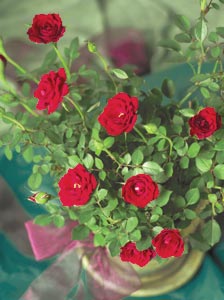
Miniature Red Rose
  • MINIATURE ROSES: True roses, 6-12" tall with miniature canes, everblooming. Can also fall under the climbing sports category of climbing roses.
Climbing Rose
  • CLIMBING ROSES: Two categories here. Natural Climbers (large flowered except for miniatures) and climbing sports of bush roses. Some popular names to look for:
Solo     New Dawn  America*  Golden Showers*

Tomorrow Rose School continues: Now that you know the different types of roses, how should you choose one?

Sunday, January 22, 2012

Rose School- Meet Sunshine Daydream


As promised today we will talk about Sunshine Daydream, the 2012 AARS rose winner.

What is an AARS winner? AARS stands for the All-America Rose Selections organization. AARS is a nonprofit association of rose growers and introducers dedicated to bringing exceptional, easy-to-grow roses to gardeners across the county. AARS operates the world's most rigorous plant trial program via its national test garden network which represents all climate zones. This sophisticated evaluation process results in a new crop of AARS winning roses each year, guaranteeing that only the best make it into your garden. AARS strives to identify roses that are easy to grow.


Once a rose is chosen it is then planted in more than 130 sample gardens around the country so gardeners can see the rose for themselves. To be chosen as an AARS winner, Sunshine Daydream thrived during two years of comprehensive testing in 21 gardens nationwide. In fact, AARS-winning roses must flourish in 15 categories including the ability to resist disease, vigor, flower production, flower shape, fragrance, petal count, overall beauty and general ease of maintenance. Each winning rose bears the AARS red-rose seal of approval that ensures gardeners the plants will grow beyond expectations with little maintenance.

Sunshine Daydream

A grandiflora with a 25 petal count of light yellow flowers with no fragrance, may have up to eight 3" blooms on a single stem! With proper pruning, it will continue to bloom all summer long. This bushy rose grows to be five feet tall and four feet wide. It was debuted to the world at this year's Tournament of Roses Parade on the Bayer Advanced Garden of Imagination float.

Tomorrow we will learn all about the rose itself. What's the difference between a floribunda and a grandiflora? Tune in tomorrow!

Saturday, January 21, 2012

Rose School-Hulthemia

I'm excited about this week's blog because I thought we could learn together all about roses. So, here goes...Rose School!


We talked before about it being bareroot time and so I am skipping ahead to tell you about some new roses to look for this season while you can still find them in bareroot. Then we will go back and learn the different kinds of roses.


I learned about a new hybrid that created a brand new type of rose...one that has a dark center. It's called "HULTHEMIA". It took Physician Jim Sproul 15 years to develop this beautiful hybrid, which he bred into two new roses, called Eyeconic Lemonade and Eyeconic Pink Lemonade.


Some other fun new ones are:

  •     Ketchup and Mustard, a red and yellow floribunda stunner
  •     Itty Bitty Pink, an abundance of bubblegum pink miniature flowers
  •     Orchid Romance, highly fragrant and 75 petaled ruffled blooms of pink
  •     Koko Loko, milk chocolate colored finished in lavender, 30- 35 petals
  •     All A'Twitter, sparkling orange miniature
  •     Sugar Moon, a pristine hybrid tea rose
  •     Stormy Weather, a smoky purple climber with cloudy white on reverse, flowers and repeat blooms in it's first season

Tomorrow, all about Sunshine Daydream and the All American Rose Selections.


Friday, January 20, 2012

Surprise!

Onions
Now that we have finished cleaning the back garden, the front garden gets our attention. After removing most of the dead stuff, I went to tackle some weeding.

Weeding has to be right up there with cleaning toilets and scrubbing off wallpaper (you know who you are).BUT it does have immediate rewards. So keeping that in my mind, I tackled the area that has been ignored for a month.

Surprise! The onion sets I had forgotten that I had planted back before Christmas were working hard to show me they were there. I was thrilled because last year, the squirrels ate them all and we're hoping that they will mature earlier before squirrels romp in the Spring.

They are many little surprises we come across and we make sure to alert each other when we see one so we won't miss it. Some of these bulbs flower for only one day. Here is one that bloomed today we are sure you'll enjoy.
Narcissus Paperwhite

Thursday, January 19, 2012

Patience

One thing I work on a lot is patience. Not one of my strong points. Here in the garden, nature teaches you to be patient and good things will follow.

In the above photo, I have made a compilation of time shots of the same plant. First you just see its tiny head poking through, then the delicate sheath that holds the flowers lets some of the blossoms out. Next the first flower blooms and soon you have a bunch of blooms, their bright happy faces greedily sucking up the sun. All because you had patience and faith that soon a beautiful flower would appear. "They who plant a seed in sod and wait for growth believe in God".

What I can't share with you here is the fragrance...heady and lilting, it floats in the air as the flower heads nod sleepily in the breeze.You can bet that our fairies are celebrating tonight the arrival of the first daffodil in the garden.

Wednesday, January 18, 2012

Windchimes

Today when thinking of my blog topic, I heard my garden. Remember how I mentioned that you need to listen to your garden? Well, I do.


Today I heard the wind blowing softly as the sunshine warmed up the ground and the tiny green heads started to look around for the new year.


Ravens were scolding each other and trying to play "chicken" with the papa birds anxiously guarding new nests.The sparrows and finches were combing the ground for that last errant seed, and the fish splashed in the pond, enjoying the unexpected sunshine. Our garden is waking up and rubbing the sleep from it's eyes to see Spring coming.


When planning your garden, don't forget to add elements that make sound and movement. Even inside the house, I heard my windchimes keep the garden beat, tolling the rhythm of the things that grow, the things that fly and the things that crawl and scurry. In a later blog entry I will show you some of the windchimes we have and some we have made. In my estimation, you can never have too many windchimes.


Tuesday, January 17, 2012

The Promise

Today one of our favorite roosters passed away. He was a good boy and very caring of his women.He lived a very long and happy life. So of course I was thinking of him when I resumed my cleaning of the garden.

It made me think of loss and how many of you have experienced loss in some way. To lose a loved one is especially hard, and to go on, even harder.

It made me think of how my Mom studied Elizabeth Kubler-Ross, who developed the five stages of grief. Lo and behold, later this afternoon as I was cleaning out our big garage I came across her book! ( THAT was a Mom-shot).

I thought about how gardening envelops loss. How the seasons go on, even when we don't. I guess that is God's promise to us- that life will go on and He will be there with you.

I could ramble on but I'm afraid of getting preachy so in Kubler-Ross' book I found this wonderful poem that says all I wanted to say.It was written by Orville Kelly, a man in the later throes of cancer who started a movement called "Make Today Count".He wrote this for his wife, Wanda. Hope you enjoy it as much as I did.

Spring, and the land lies fresh green
Beneath a yellow sun.
We walked the land together, you and I
And never knew what future days would bring.
Will you often think of me,
When flowers burst forth each year?
When the earth begins to grow again?
Some say death is so final
But my love for you can never die.
Just as the sun once warmed our hearts,
Let this love touch you some night,
When I am gone,
and loneliness comes-
Before the dawn begins to scatter
Your dreams away.

Summer, and I never knew a bird
Could sing so sweet and clear,
Until they told me I must leave you
for a while.
I never knew the sky could be so deep a blue
Until I knew I could not grow old with you
But better to be loved by you,
Than to have lived a million summers,
And never known your love.
Together, let us, you and I
Remember the days and nights,
for eternity.

Fall, and the earth begins to die,
And leaves turn golden-brown upon the trees.
Remember me, too, in autumn, for I will walk with you,
As of old, along a city sidewalk at evening-time,
Though I cannot hold you by the hand.

Winter, and perhaps someday there may be
Another fireplace, another room,
With crackling fire and fragrant smoke,
And turning, suddenly, we will be together
And I will hear your laughter and touch your face,
And hold you close to me again.
But, until then, if loneliness should seek you out,
Some winter night, when snow is falling down,
Remember, though death has come to me,
Love will never go away.
Our first bulb bloomed today!

Monday, January 16, 2012

Christmas Cactus

I received a text from my sister Betty today. She lives about an hour and a half away from us nearer Los Angeles, at a lower elevation. She has an amazing garden as well and she shares with me. She, after many years, finally had her Christmas Cactus bloom.
Betty's Christmas Cactus finally bloomed!
Now I own many Christmas cactus and had no idea it was such a journey to get them to bloom. My MIL tells me to 'starve them of water' and they'd bloom right away (see below). I don't do that as I have a thing about not abusing my plants. If they don't want to bloom, that's up to them. I'm so lucky that they seem to love to bloom for me.

One of Our Christmas Cactus

Another of our cactus

Another happy cactus


Christmas Cactus or it's official name "Schlumbergera" is also known as the Thanksgiving Cactus. It's a pretty plant and does not look like your traditional cactus, but more like a succulent.


Most species of Schlumbergera have stems which resemble leaf-like pads joined one to the other and flowers which appear from areoles at the joints and tips of the stems in white, pink, yellow, orange, red or purple.


According to Wikipedia:  LightThey can be damaged by exposure to more than small amounts of sunlight.and are more tolerant of high light levels. Too much light causes stems to take on a reddish coloration; however, very low light levels will prevent flowering. Day length is important in controlling flowering; continuous darkness for at least 12 hours is necessary to induce bud formation. A period of about 8 days with 16 hours of darkness at 61 °F has been shown to cause flower buds to form. Lower temperatures slow this process. The advice sometimes given to withhold water to produce flower buds has been shown to be incorrect.


It's always amazing to us that we can grow this plant here where it freezes at night in the Fall/Winter, although I have to admit they do live in the greenhouse.


BJ2DHGTQWB4F


Sunday, January 15, 2012

It's OVER, Baby...

I would be remiss if I didn't mention that not all bulbs come back every year. Some are annuals and bloom only once. I have heard that tulips in America are annuals; but where we live it gets cold for a long period so our tulips do return.Guess it depends on the type and where you live.


Most bulbs need to be dug up and parted out because they will stop blooming after a few years.Once parted out and replanted you should be good for a few more years.


Here are some reasons why bulbs do not flower (It's OVER, Baby...):


  • OVER-watering:  Most bulbs come from a hot climate and have dry summers.
  • OVER-done: Bulbs that have dried out or gone soft or moldy.
  • OVER-time: Bulbs that are planted at the wrong time, without enough cold time to develop
  • OVER-shade: Not enough sunshine 
  • OVER-crowded: Too many bulbs grow together and the blooms get smaller and smaller and eventually stop blooming
  • OVER-eaten: Munched on or dug up by animals, like moles or deer
  • UNDER-planted: Too close to the surface exposes the bulbs to frost and wind drying.
 
Bulbs are really easy to maintain with big rewards to follow! Just dig a hole, place bulb, cover with dirt, water and enjoy when they bloom!

Saturday, January 14, 2012

All About Bulbs

Today I promised to continue about my obsession with bulbs. There are Spring flowering bulbs and Summer flowering bulbs and the fun thing to do with your garden is timing your plantings so you have flowers almost all year round. This is what we did in our garden and by the time the bulbs are done the mums are kicking in.Then the perennials are going, too.

Now, some more about the bulbs themselves.You want to do the 'squeeze' test and choose ones that are firm and not soft and do not have black or brown spots on them.Some bulbs LOOK dead but aren't.In the photo below this bulb should be discarded as it has black spots and was very dried out.  
Naked Lady Bulb
When planting follow the guide on the package as each type of bulb requires a different planting depth. As a rule plant the bigger bulbs deeper, like 6 inches and the smaller bulbs 4 inches.

Plan your plantings in an area with plenty of sunshine. Make sure there is sunshine available for them AFTER they flower for that is the time when they build their 'fat' to live on through the winter.

Once your bulbs are planted, they need little care and most will come back year after year.I often forget where I planted them until they happily surprise me by poking their smiling faces up to the sun.

Friday, January 13, 2012

B Is For Bulbs!

They say confession is good for the soul...so I must confess I am addicted to bulbs.I simply cannot resist them.

For those of you who have never planted bulbs...WHERE HAVE YOU BEEN? Planting bulbs is so easy and simple. Check out this chart from bulbinfo.com. It made me laugh when I saw it. Perfect for the blog, I thought!


What they don't tell you is what is the top and what is the bottom of the bulb.The top is where the shoots grow up and the bottom is where the roots grow down. Sometimes it's tricky to see, but as a rule of thumb look at these glad bulbs I planted today, along with an invaluable planting tool that will save you bending over to dig.See how the top forms a little peak, like a teeny hat? The bottom has more like a ring for the roots to grow out and stabilize the flower when it grows so tall.


Where we are located it gets cold at night in the Fall and Winter so the bulbs get their hibernation in the cold just right. If you live in warmer areas it is suggested that you store your bulbs in the refrigerator for 4-6 weeks before planting. The cold signals their time to get ready to start the growing process once the nice warm sunshine is around. More about bulbs tomorrow.

Thursday, January 12, 2012

Have help in the garden

When working in the garden, clearing the old growth and debris can be very tedious. I use the time to work out solutions in my head to creative projects, plan steps to my next project or just free think.

When you allow your mind to be completely free, the most amazing creativity comes through. Usually your mind is constantly going over the daily chores and annoyances so that there is not very much down time. Free thinking allows your mind to be free. It's like recess for your brain.

Gardening has been found to lower blood pressure, help with depression, anxiety, etc. It's like God's therapist. Give yourself a chance to tune in and see what you discover.

And when you are attacking the "Christmas weeds" as Aunt Ruth calls them (because they grew over the holidays when you were focused on Christmas), be sure you have some help. I always do.

Wednesday, January 11, 2012

Our Garden, Our Heaven

I want you to take a moment to close your eyes and imagine what your perfect garden would look like. Would it have huge shady trees with sheltering arms, tucked away places to sit and read, bird feeding stations, birds splashing in shallow baths, winding meandering paths, spectacular views, incredible flowers and foliage,  hidden ponds, birdhouses hidden in leafy climes?


Would fairies live there among guardian winged creatures? Is it a place where rainbows appear out of nowhere and the air seems to sparkle and glow? Ahh, I see you've been to our garden. And we are the lucky caretakers. Our garden, our heaven.

Tuesday, January 10, 2012

Hello, it's your garden calling...


Today the weather continued to cooperate with plenty of sunshine.As I worked clearing and cleaning, I listened to the birds chatter excitedly to each other; I heard ravens caw hello and I heard my garden.


Now I know that sounds funny but it's true. You have to listen to your garden. It will alert you to areas that need help but most of all, it will bring you peace. Living in the moment helps you lower blood pressure, work out problems, relax and let your mind free think. It is a liberating experience.

Monday, January 9, 2012

Which weed is weed?

False Aralia
Today I promised to share with you why yesterday's story made me laugh.
My mother always had a wonderful garden and when she lived in Orange County she had a side yard visible and accessible to the street and sidewalk. She had several plantings there but it didn't get a full day of sun so she had to really search to find plants that would thrive.
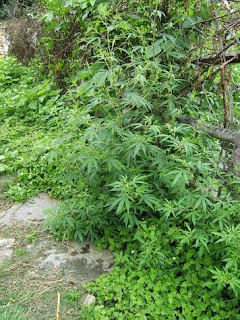
She found some lovely false aralia but mysteriously as soon as she planted it the entire plant seemed thinner each day until it disappeared completely ...three different times! We thought maybe a gopher but no...it was human! Kind of a coincidence that false aralia looks similar to this plant...
Marijuana

Marijuana! We only hope whoever was smoking it was wondering a little why it wasn't potent enough! Sometimes crime doesn't pay (but it sure can be funny!)

Sunday, January 8, 2012

Surprise!

Remember a few blogs back I talked about how fun it was to get a new plant from a friendly neighbor? Maybe I should add that it is helpful to at least know who you are getting them from, what you're looking at and do some research. Here's an article I saw that made me laugh..Tomorrow I'll tell you why.(Our thanks to AP News Feed)
Pa. grandma says she was duped by stranger's seeds
UNIONTOWN, Pa (AP)- A southwestern Pennsylvania grandmother says she's no marijuana grower, just a woman who wanted something that would look pretty next to her tomatoes.

A Fayette County jury cleared 67 year old Alberta Kelley of drug possession and manufacture charges on Wednesday after she told them she simply tossed a handful of seeds into her garden after a bearded stranger gave them to her.

Connellsville police charged Kelley a year ago after receiving a tip about her garden. Investigators found seven well-cultivated four foot marijuana plants behind her home.

But Kelley claimed she didn't know what she was growing. She said she had been given the seeds by a stranger in a pointy hat who told her that they were flower seeds.  Kelley tells WTAE TV that to her "weeds are weeds".  

Saturday, January 7, 2012

Garden Maintenance

     The weather continues to be nice and sunny and although we aren't inundated  with flowers there are a few still surviving.


It's about time to remove the cover from the pond. Normally this would be a little early in the year to do this but the weather has been sunny and it can create ammonia in the water when the dead leaves ferment. So it's important to remove the dead plant matter.


We have two ponds, one in front and one in back. This year hopefully we will be renovating the front one, as a squirrel decided to make it a home, so it was drained and needs to be cleaned before it's filled again. That's another HUGE project for another day!


Friday, January 6, 2012

Timing


I would be remiss if I didn't mention it's bare root time!The above pic reminded me of it. We bought this beautiful rose last year and not only does it look outstanding (no two roses alike), it also smells like apple! As we learned, you miss bare root time and it's over and you will have to wait until next year's bare root time.


It is an extremely short time to get roses, fruit trees and berries in bare root stock. Usually by February the bare root stock are pretty much gone and aren't coming out until next year.


All plants come with planting instructions but the most important thing to do is soak your bare root plant in a bucket of water overnight to plump up the roots.


So start looking for the bare roots and we bet you see them all over, even at the grocery store!

Thursday, January 5, 2012

Garden musings

Today was more garden cleaning so I found my mind wandering- a nice side effect of gardening. It was nice and softly sunny and as the ravens cawed and birds flew overhead, I thought about my mom and how she loved flowers. She was the kind of person people fell in love with so easily.
When I was growing up, after dinner we would often go for a walk with the dogs and she would invariably see a plant or flower in someone's yard and before you could blink she was knocking on the door and soon we were walking back home with handfuls of that new plant and mom had made a new friend. And every time we saw that plant growing and blooming in the garden we would remember that kind person who shared it with us, so we could share it with others.All for the mutual love of gardening.